You do not need AI answers. You need autonomous resolution.
When tickets bounce between queues, when customers repeat themselves on chat then phone then email, when after-call work eats half your day, you do not have a knowledge problem. You have an execution problem. The work is not “tell me the policy.” The work is “do the thing in the system, correctly, and prove you did it.”
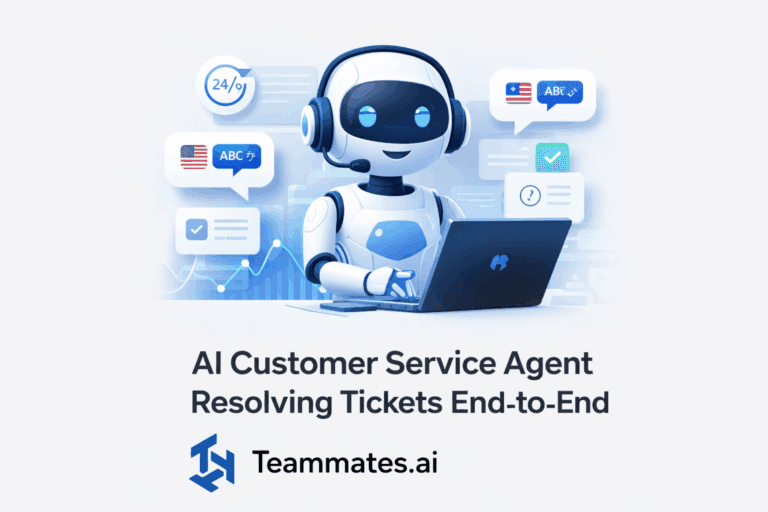
AI Teammates are not chatbots. Not assistants. Not copilots. Not bots. At Teammates.ai, each Teammate is a coordinated network of specialized AI Agents, each responsible for part of the workflow: intent capture, identity checks, tool execution, escalation packaging, and documentation.
Key Takeaway: staffing changes only when tickets get resolved end-to-end without human cleanup. That is why autonomy must include action-taking, not just conversation. And in an autonomous multilingual contact center, “multilingual” means consistent outcomes in 50+ languages, not translated scripts that drift under pressure.
The operational anatomy of an AI customer service agent at a glance
An autonomous ai customer service agent has four required systems working together. If any one is missing, your humans inherit the hardest parts: risk, tool work, and reporting. That is where handle time and recontacts come from.1) Conversation layer (omnichannel, multilingual, escalation-aware)
This is where most vendors stop. It includes chat, voice, and email handling, tone control, and robust intention detection that survives messy reality: code-switching, partial info, and angry customers. Arabic support is a great litmus test because dialect and transliteration punish brittle intent models.2) Identity layer (verification and consent, not vibes)
If the request is account-specific, the agent needs a verification flow: step-up checks, consent capture, and data minimization. “What is your last order total?” is a control. “Tell me your full card number” is a failure. Fraud-aware checkpoints are not optional for password resets, address changes, and disputes.3) System actions layer (secure tool execution)
Autonomy means the agent can take actions in Zendesk, Salesforce, HubSpot, order management, billing, shipping, and scheduling systems. The autonomy metric is action success rate: tool-call success, retries, rollbacks, and clean failure handling. If a refund fails, the agent must know whether to retry, route to finance, or ask for a different payment method.4) Documentation layer (structured closure and auditability)
Every resolved case needs clean artifacts: summary, tags, disposition codes, timeline of actions, and next steps. If you cannot audit what happened, you cannot scale autonomy in regulated environments or even run decent QA.
For deeper architecture detail, see our view of an ai conversational platform built for resolution, not just talk.
Where typical chatbots stop and why your staffing model does not change
Chatbots answer FAQs and then hand off. That sounds fine until you look at your ticket mix. The volume is dominated by “do something” intents: cancel, refund, change address, reschedule, verify identity, update payment, dispute a charge. If the agent cannot act, you still pay humans to do the work, plus you pay the tax of duplicate conversations.
Common failure modes you have already seen:
– Looped troubleshooting because the bot cannot check system state.
– Handoffs that drop context, so the customer repeats everything.
– Inconsistent answers between chat and email because prompts diverge.
– Multilingual drift where translations change meaning and policy compliance breaks.
Direct answer: Will an AI customer service agent replace human agents? It replaces the repetitive resolution work first, not the entire team. Humans stay focused on exceptions, high-impact decisions, and relationship-saving escalations, while the autonomous agent absorbs volume with consistent documentation.
If you want a practical view of agents that actually execute workflows, this is the bar for an ai agent bot.
FAQ chatbots fail for one operational reason: they end at “here’s the answer” and push the hard part (verification, system updates, refunds, cancellations, disputes) back to your team. That does not reduce backlog. It reshuffles it. The queue still fills with “do something” tickets, and your agents still do the after-work.
Common failure modes you already recognize:
- Looped troubleshooting: the bot keeps asking the same diagnostic questions because it cannot read the account state or run a real check.
- Broken handoffs: the customer repeats themselves because context was never written to the ticket in a usable way.
- Channel inconsistency: chat says one thing, email says another, voice escalations start from zero.
- Multilingual drift: translated scripts miss intent when customers code-switch (especially in Arabic dialects), so the bot “answers” the wrong problem.
Key Takeaway: if the system cannot close the ticket with clean documentation, it cannot absorb volume sustainably. This is why we anchor autonomy to action success rate, not deflection.
Teammates.ai and Raya are built for autonomous omnichannel resolution
Autonomous resolution requires an integrated architecture, not a prettier chat widget. Raya (by Teammates.ai) is designed to resolve tickets end-to-end across chat, voice, and email by combining conversation control, identity checks, secure tool execution, and auditable documentation. The point is outcomes: fewer open tickets, fewer touches, consistent quality in 50+ languages.

What “integrated” means in practice:
- Raya connects into systems like Zendesk, Salesforce, HubSpot, and internal order and billing tools so it can read state, take action, and confirm completion.
- It uses strong intention detection so routing is outcome-based (refund vs address change vs dispute), not keyword-based.
- It escalates intelligently when risk is high (PII exposure, payment issues, uncertainty, angry customers) with a handoff packet: goal, identity status, tools called, results, and the recommended next step.
If you are also scaling revenue and hiring, the same “screen at scale” constraint shows up elsewhere. That is why Teammates.ai pairs Raya with Adam for autonomous revenue conversations and Sara for scalable interviews. Different workflows, same requirement: controlled autonomy with proof.
Implementation playbook for deploying an AI customer service agent from 0 to 1
You do not “turn on” an AI customer service agent. You stage autonomy. The teams that win treat this like an ops rollout with gates, not a prompt-writing exercise.
A practical 0 to 1 plan:
- Week 0 discovery: rank top intents by volume, cost, and risk. Pick 10-20 intents where the system action is straightforward (order status, appointment scheduling, password reset, address update with verification).
- Data readiness: clean KB articles, normalize macros, enforce ticket tagging and disposition codes, and define “done” criteria per intent. If you cannot define done, you cannot automate it.
- Integration setup: connect ticketing, CRM, order and billing, and identity provider. Explicitly mark tools as read-only vs write-enabled. Start narrow, expand permissions as success proves out. If you want the architecture pattern, start with an ai conversational platform that is built to execute workflows, not just chat.
- Conversation design: build an intent taxonomy, clarification questions, and channel rules (voice brevity, email structure). Multilingual customer support needs language-specific tone and disambiguation, not machine translation pasted on top.
- Safety policies: define restricted topics, compliant phrasing, and approval gates for high-impact actions (refunds, cancellations, disputes, account changes).
- Human handoff: require a structured packet so escalations reduce handle time instead of creating rework.
- Phased launch: internal dogfood, low-risk queues, mixed queues, then 24-7 coverage. Launch gates should be tool-call success and policy compliance, not vibes.
Common pitfalls: starting with rare edge-case intents, shipping without tagging discipline, and launching without multilingual test sets (especially Arabic variants).
Governance, risk, and compliance for autonomous support that executes actions
Governance is not a legal checkbox. It is the constraint that lets you safely scale autonomous actions. Without it, you will cap automation at “answers” forever because leadership cannot approve write access.
Minimum governance controls for autonomous support:
- Data classification and redaction (PII, PCI, HIPAA where applicable), plus retention rules and consent capture.
- RBAC for tool permissions and step-up verification for sensitive requests (account takeover risk lives here).
- Approval gates for high-impact actions: refunds above a threshold, cancellations inside penalty windows, address changes near shipment, disputes.
- Audit logs that tie every system action to a conversation, a policy version, and an outcome.
Vendor questions that surface reality fast:
- Is SOC 2 or ISO scope aligned to the product you are buying, or just corporate IT?
- What are the sub-processors and data residency options for multilingual deployments?
- How is PII minimized in logs and training, and can you prove it?
- Are tool actions fully auditable, including retries, rollbacks, and partial failures?
Key Takeaway: autonomy without governance becomes an operations liability. Real autonomy is controlled autonomy.
Evaluation beyond deflection using a quality and safety scorecard
Deflection is a vanity metric. The autonomy metrics are: can it resolve, can it act safely, and can it document cleanly. If you cannot measure those, you cannot run an autonomous multilingual contact center with confidence.
Use a scorecard with metrics broken down by intent, channel, and language:
- Resolution rate (end-to-end closed) and containment (no human touch)
- Time-to-resolution and CSAT impact
- Tool-call success rate (including retries and rollback success)
- Hallucination rate and policy violation rate
- Handoff quality score (did escalation include identity status, actions taken, and next step?)
Build test sets the same way you build QA: “golden conversations” per intent (happy path, edge cases, adversarial, multilingual variants), plus weekly samples from real tickets. Run offline evals before expanding scope. This is how you avoid silent regressions in low-volume languages and voice flows. If you want the workflow view, see how an ai agent bot is evaluated on execution, not chatter.
Conclusion
An AI customer service agent is only autonomous if it can verify identity, take secure system actions, and document outcomes end-to-end across chat, voice, and email. Anything less is Q and A with a new label, and it will not change staffing, backlog, or SLAs.
Build for autonomy the way you build for uptime: start with a tight intent set, integrate the tools, add governance gates, and expand only when tool-call success and policy compliance hit your bar. If you want a system designed around that operational anatomy (including multilingual support with Arabic-native handling), Teammates.ai Raya is the straight-line choice for serious customer operations.