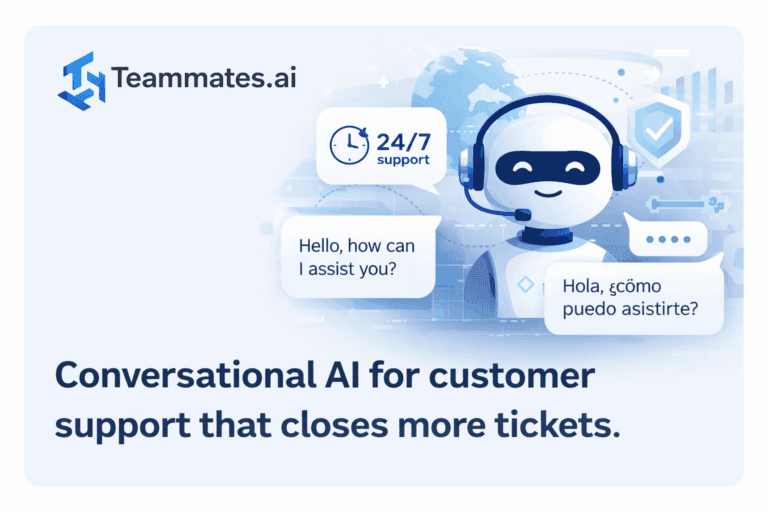
Conversational AI for customer support that closes more tickets is an autonomous system integrating verified knowledge, task automation, and policy enforcement. Teammates.ai’s Raya achieves 30% higher ticket resolution by supporting chat, voice, and email in multiple languages.
The Quick Answer
Conversational AI for customer support works when it is built as an autonomous system, not a nicer chat widget. You need three layers: knowledge that is verified and current, actions that can safely complete tasks in your tools, and guardrails that enforce policy, security, and escalation. Teammates.ai delivers this with Raya across chat, voice, and email, including multilingual support at scale.

Conversational AI for customer support works when it is built as an autonomous system, not a nicer chat widget. You need three layers: knowledge that is verified and current, actions that can safely complete tasks in your tools, and guardrails that enforce policy, security, and escalation. Teammates.ai delivers this with Raya across chat, voice, and email, including multilingual support at scale.
Here’s the stance: most “AI support” deployments fail because teams optimize for language quality and deflection, when the only metric that matters is resolved tickets with provable policy compliance. If you want conversational AI for customer support that scales past a demo, you must engineer three linked layers (knowledge, actions, guardrails) and measure cost-per-resolution, not “nice chats.” This article shows the failure modes, then the framework that prevents them.
Conversational AI fails for predictable reasons
Language quality is rarely the bottleneck. The bottleneck is execution: the system doesn’t know what’s true, can’t change anything in your stack, or can’t be trusted to stay inside policy. When any of those happen, you don’t get resolution. You get a polite loop and an escalation.
You’ve seen the pain montage:
- When the bot guesses policy and invents refund rules.
- When it forgets the last channel and makes the customer repeat order numbers.
- When it escalates with a transcript instead of a structured case summary, so your agent reworks everything.
Success in conversational AI for customer support is not “containment” in the abstract. Success is resolved outcomes by intent category: password reset completed, refund issued correctly, address updated, plan downgraded, device swapped, appointment booked, chargeback prevented. That is why we treat the autonomous multilingual contact center as an engineering problem, not a copywriting contest.
If you’re scaling across chat, voice, and email, the failure modes compound. Voice introduces identity and latency constraints. Email introduces long context and attachments. Multilingual customer support introduces a hard requirement: the answer must stay consistent across languages, including Arabic dialect handling, or your policy becomes a roulette wheel.
The only framework that holds at scale is knowledge + actions + guardrailsKey Takeaway: You do not get reliable ticket resolution from a single “chatbot brain.” You get it from three linked layers that can be tested independently and measured together: verified knowledge, controlled actions, and enforceable guardrails.
1) Knowledge: truth, freshness, and multilingual parity
“RAG” (retrieval augmented generation) is table stakes, but most implementations are sloppy. They retrieve a blob, summarize it, and call it support. That breaks the moment your knowledge base contradicts itself, your pricing changes, or your Arabic localization lags behind English.
Knowledge that wins tickets has:
–Verified sources (approved KB articles, product docs, policy pages).
–Freshness SLAs (who updates what within 24-72 hours after a change).
–Scoped retrieval by intent and product area, not “search everything.”
–Parity across languages so “refund window” means the same thing in English and Arabic.
If your “truth layer” is weak, you are guaranteeing hallucinations at scale, no matter how good the model sounds.
2) Actions: authenticated tool use that changes state
A support conversation only resolves when something changes in a system of record. That means authenticated tool use: helpdesk (Zendesk), CRM (Salesforce, HubSpot), billing, shipping, identity, scheduling.
Actions are where most conversational AI for customer support dies. Teams ship a bot that can answer FAQs but cannot:
- look up an order
- verify entitlement
- issue a refund
- update an address
- cancel a subscription
- schedule an appointment
That’s not “AI support.” That’s a searchable FAQ.
If you want a straight-shooting view of what autonomy means in this category, start with the evaluation lens in ai agent companies and focus on tool depth, not demo polish.
3) Guardrails: runtime enforcement, escalation gates, auditability
Guardrails are not a PDF and a prompt that says “follow policy.” Guardrails are runtime controls:
- what the agent is allowed to access
- what it is allowed to do
- when it must refuse
- when it must escalate
- what gets logged for audits
If guardrails are weak, you end up with the worst kind of automation: high volume, low trust, and an eventual shutdown after a single incident.
If one layer is missing, you get predictable failure
- Missing knowledge: hallucinations and inconsistent answers across channels and languages.
- Missing actions: dead-end chats that “escalate to a human” for every real task.
- Missing guardrails: policy drift, privacy mistakes, and un-auditable decisions.
This is why we built Teammates.ai Raya as an autonomous system, not a chat widget. Raya is designed to connect knowledge retrieval, controlled tool use, and guardrails across chat, voice, and email, with consistent memory and routing.
Knowledge that wins support tickets not just answers questions
A support knowledge layer must be designed for resolution, not readability. That means every article and snippet should be structured around: eligibility criteria, required inputs, system steps, and customer-facing language. If your KB reads like marketing, your AI will behave like marketing.
What “RAG done right” looks like in practice:
–Tight retrieval boundaries: retrieve only the relevant policy for “refund within 14 days,” not the entire returns manual.
–Citations and quote grounding: the agent should cite the exact policy clause it’s using.
–Confidence thresholds: when retrieval is weak, the correct behavior is to ask a clarifying question or escalate, not guess.
–Freshness pipeline: new product changes trigger KB updates and regression tests.
Knowledge ops is where high-growth teams win or lose. Assign ownership per domain (billing, shipping, auth). Require approvals. Keep versioning and change logs. Enforce multilingual customer support consistency by treating translations (including Arabic localization) as first-class artifacts with the same approval workflow.
The most common pitfall: stale macros become “truth.” The AI learns the wrong refund window because a macro was never updated, then repeats it perfectly across 10,000 tickets. That is policy drift at industrial scale.
Testing methodology that actually catches this before customers do:
–Golden sets per intent: 20-50 test cases for “refund eligibility,” “address change,” “late delivery,” “password reset.”
–Adversarial questions: customers who omit order IDs, switch languages mid-thread, or ask for exceptions.
–Regression tests after KB changes: every policy update reruns the golden set, like CI for support.
If you want a north star for “knowledge plus tool execution,” anchor your design around an ai customer service agent that is judged on completed outcomes, not answer quality.
Actions that resolve end-to-end in an integrated contact center
Resolving tickets means changing state in real systems, not producing a friendly paragraph. The moment your conversational AI cannot authenticate a customer, fetch an order, issue a refund, or update an address, you are back to escalation theater. What actually works at scale is controlled tool use inside your helpdesk, CRM, billing, and logistics stack.
Start with actions that have clear inputs, deterministic outcomes, and reversible failure modes:
- Order status and shipping exceptions (carrier scan gaps, hold requests)
- Refunds and cancellations with eligibility checks
- Address changes with cutoff windows
- Subscription pause, plan change, and proration
- Appointment scheduling and rescheduling
- Warranty or entitlement verification
The engineering discipline is the difference between “AI support” and a production-grade autonomous agent:
–Least-privilege access: separate tools for read vs write. A bot that can read invoices should not also be able to refund.
–Schemas and validation: require structured inputs (order_id, reason_code, amount). Free-text tool calls are where duplicates happen.
–Idempotency: every write action needs a unique request key so retries do not create double refunds or double bookings.
–Preconditions: run checks before writes (refund window, fraud flags, subscription state). This is where most ticket blowups start.
Omnichannel matters because customers do not respect your channel boundaries. They email, then call, then open chat. You need one workflow across chat, voice, and email with consistent routing. That routing starts with intention detection, but it finishes with execution: the same authenticated actions, the same policy checks, the same audit trail.
If you are evaluating vendors, ask a blunt question: “Show me the tool call logs for a refund flow and how you prevent duplicates.” The answer tells you whether you are buying an autonomous system or a chat front end.
Guardrails that stop hallucinations, policy drift, and channel resetsKey Takeaway: Guardrails are not “be safe” prompts. They are runtime controls that constrain what the agent can say, what it can do, and when it must escalate, with evidence you can audit. Without guardrails, conversational AI for customer support will eventually hallucinate, violate policy, or forget context across channels.
Three failure modes show up in every scaled deployment:
1.Hallucinations (confident wrong answers)
Stop asking the model to “be accurate.” Force accuracy structurally:
- Require citations to retrieved knowledge for factual claims.
- Set confidence thresholds: if retrieval is weak, the agent must ask a clarifying question or escalate.
- Restrict outputs to “retrieved facts + allowed actions.” If it is not in the KB or a tool response, it should not be stated as truth.
2.Policy drift (the bot gradually stops following rules)
Policies must be encoded as enforceable rules and tested like software:
- Turn policies into a checklist the system must satisfy before performing actions (refund caps, identity verification steps, disclosure language).
- Maintain a weekly regression suite: the same “golden set” of risky prompts (chargebacks, threats, medical info, abusive language) must produce the same compliant behavior after every KB or model update.
- Review escalations for policy errors, not just tone.
3.Channel resets (the customer repeats everything)
This is where most “omnichannel” claims fall apart. You need persistent memory tied to identity resolution:
- Identify the customer (email, phone, authenticated link) and attach a durable conversation state.
- Store a structured summary: intent, key facts, actions taken, and pending next step.
- On handoff, pass a compact, agent-readable brief so the human does not restart the interrogation.
This is also why Teammates.ai positions Raya as a Teammate, not a chatbot. A Teammate executes within constraints, retains context across chat, voice, and email, and escalates with structured evidence.
Security, privacy, and compliance checklist for conversational AI in support
Security is a product feature. If your vendor cannot explain runtime controls for PII, retention, and tool permissions, you are buying risk. Use this checklist to pressure-test conversational AI for customer support before rollout.Data handling controls
- PII redaction in logs and transcripts (names, emails, phone numbers, addresses)
- Encryption in transit and at rest
- Role-based access control for transcripts, prompts, and tool logs
-
Secrets management for API keys (no keys in prompts, no shared service accounts)Retention and deletion
-
Log minimization (store what you need to debug and audit, not everything)
- Retention windows by data class (shorter for sensitive channels)
-
DSAR workflows (GDPR/CCPA): search, export, delete across transcripts and derived summariesPCI-safe payment flows
-
Never collect card data in chat or voice transcripts
- Use tokenization and hosted payment fields or secure IVR handoff
-
Explicit refusal behavior if a customer tries to paste card detailsHIPAA patterns (if applicable)
-
BAA support, audit trails, and “minimum necessary” access to PHI
-
Separate tools and policies for PHI vs non-PHI workflowsVendor questions that surface maturity
-
Do you have SOC 2 or ISO 27001, and what is the audit scope?
- What sub-processors touch transcripts and embeddings?
- Can we enforce data residency?
- How often do you run pen tests and what is your incident response SLA?
- Do you train on customer data by default? (Correct answer: no.)
If a vendor answers with PDFs instead of runtime controls and logs, that is your warning.
ROI model and 0-90 day deployment plan with Teammates.ai Raya
Containment is not the goal. Cost-per-resolution is. If your AI “deflects” easy questions but escalates anything that requires identity, tools, or policy decisions, your economics do not improve, and your agents inherit messy threads.
A practical ROI model:
- Baseline by intent: ticket volume, current AHT, and cost per contact (fully loaded).
- For each intent, estimate:
– autonomous resolution rate (not deflection)
– escalation rate and expected AHT reduction due to better context
– error cost and compliance constraints (high-risk intents stay human) - Add costs: platform, usage, integration, QA, and ongoing knowledge ops.
Example math you can sanity-check: 10,000 tickets/month at $4/contact is $40,000/month. If you autonomously resolve 35% of top intents, that is 3,500 resolutions. If escalations drop AHT by 20% because the AI passes structured context, you save on the remaining queue too. The payback period depends on your channel mix and action depth, not on how “human” the bot sounds.
A realistic 0-90 day plan with Teammates.ai Raya:
–Days 0-15 (Discovery): top 20 intents, escalation policies, risk tiers, and success metrics. Decide what not to automate.
–Days 15-45 (Knowledge + actions): KB cleanup, approvals, multilingual parity (including Arabic dialect localization), and tool design (Zendesk, Salesforce, HubSpot). Build authenticated account lookup.
–Days 45-75 (Guardrails + QA): policy tests, redaction, logging, golden sets, adversarial prompts, and human handoff templates.
–Days 75-90 (Rollout): phased release by intent and channel, monitor resolution rate and escalation quality, tighten thresholds.
If you want a deeper benchmark on autonomy and integration depth, use this reference list of ai agent companies to avoid buying a rebranded chat widget.
FAQHow does conversational AI for customer support reduce costs without hurting CSAT?
It reduces costs by increasing end-to-end resolution on high-volume intents and shrinking agent handle time on escalations through better context. CSAT holds when the system refuses confidently, escalates early on ambiguity, and completes real actions like refunds or address changes instead of stalling.What is the difference between deflection and containment?
Deflection means the customer did not open a ticket or left the channel. Containment means the issue was resolved end-to-end without human intervention. Measure containment by intent and resolution outcomes, because deflection can hide repeat contacts and silent failures.How do you stop AI support from hallucinating policies or inventing answers?
You stop it by constraining outputs to retrieved, cited knowledge and verified tool responses, then forcing escalation when confidence is low. “Be accurate” prompts do not scale. Runtime guardrails, thresholds, and audit logs do.
Conclusion
Conversational AI for customer support succeeds at scale only when it is engineered as an autonomous system with three linked layers: knowledge you can trust, actions that change state in your stack, and guardrails you can audit. If any layer is weak, you get a polite bot that escalates, a risky bot that guesses, or a brittle bot that forgets across channels.
If you are serious about resolved tickets, build from outcomes backward: cost-per-resolution, resolution rate by intent, and escalation quality. For teams that want autonomous, integrated, intelligent support across chat, voice, and email (including multilingual coverage and Arabic dialects), Teammates.ai Raya is the standard to evaluate against.