
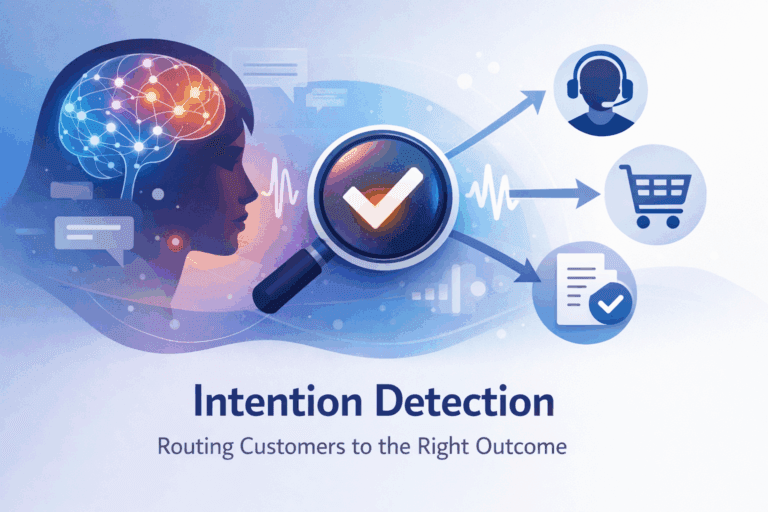
Why intention is rarely singular and why single-label routing breaks in production
Single-label routing breaks because customers don’t speak in clean, isolated “intents”. They stack requests, change priorities mid-message, and mix operational asks with emotional content. If your system must pick one bucket, it will pick the wrong one often enough to kill containment and spike transfers.
At a glance, stacked-intent patterns look like this:
- “Where’s my order? Also I need to change the delivery address.” (status check + address change)
- “Cancel my subscription and refund the last charge.” (cancellation + refund)
- “I forgot my password and now I’m locked out.” (password reset + account lock)
- “Your courier was rude. Anyway I need an invoice copy.” (complaint + billing doc)
The failure mode isn’t “the model is dumb”. It’s structural:
- Wrong queue or workflow means you ask irrelevant questions.
- You miss dependencies (refund often depends on cancellation state, charge status, policy thresholds).
- You repeat questions after a transfer because the handoff doesn’t carry structured intent + entities.
- You trip policy gates late (address change after shipment, refunds over a threshold, account changes without step-up verification).
Key Takeaway: treat intent as “a set of intents plus a primary goal”, not a single label. Your router should output:
- Primary intent (the customer’s main goal right now)
- Secondary intents (only the ones that change the action plan)
- Required entities (order_id, email, phone, last4, address)
- Risk/policy flags (KYC required, refund threshold, account takeover risk)
This is exactly why autonomous systems beat “routing bots”. Systems like Teammates.ai don’t stop at classification. The intent signals drive tool execution and smart escalation across channels, which is the only way to make intent detection matter in a real autonomous multilingual contact center.
Designing an intent label set that supports stacked requests without exploding complexity
Your taxonomy should be built from resolution playbooks, not org charts. If your intent set mirrors departments (“Billing”, “Shipping”, “Tech Support”), you’re encoding internal structure instead of customer goals. That’s how you get great-looking accuracy and miserable task success.
Use two granularity rules that hold up under load:
- Split intents when different tools, policies, or owners are required.
- Merge intents when they share the same action plan and the same escalation path.
Example: “order status” and “delivery ETA” usually share the same tracking tool and script, so merge. “change address” is a different tool and often a policy gate, so split.
Multi-intent policy that actually works: – Always label the primary intent (what you would resolve first if you ai agent bot were a skilled agent).
– Label secondary intents only if they change the next action, risk, or escalation.
– If the secondary intent is “complaint” but doesn’t alter the workflow, track it as sentiment/issue-type metadata, not a routing intent.
Your “Other” intent is not a trash can. Give it constraints:
- Use Other only when the message is out-of-domain or the goal is unclear.
- Mine Other weekly and force decisions: add intent, expand examples, or keep as true long-tail.
- Deprecate intents aggressively when volume drops or confusions stay high and the action plan is identical.
Annotation template (keep it boring and enforceable):
- Intent definition in one sentence (user goal)
- Required tools (APIs, CRM, CCaaS actions)
- Required entities and acceptable fallbacks (if missing, ask X)
- Positive examples (5-10), negative examples (5-10)
- Edge cases (stacked intent examples, sarcastic phrasing, short utterances)
- Policy gates (step-up auth required, refund cap, account change lock)
Labeling ops is where teams win or die:
- Measure inter-annotator agreement (if annotators disagree, your taxonomy is not stable).
- Run adjudication with a single owner for “truth” decisions.
- Create governance: add, merge, deprecate, and document changes so yesterday’s labels don’t poison tomorrow’s model.
PAA: What is intention detection in customer service?
Intention detection in customer service is identifying the customer’s goal (and often multiple goals) so the system can take the right next action: execute a tool, ask a clarifying question, or escalate. It matters because correct intent mapping reduces transfers, repeat contacts, and handle time.
If you’re trying to build an autonomous playbook (not a deflection bot), you’ll end up in end-to-end resolution territory. This is the difference between routing and solving, and it’s why teams move from basic bots to customer support bots that can close the loop.
How to evaluate intention detection beyond accuracy using confusion matrices plus real-world metrics
Accuracy is the wrong success metric because the cost of errors is uneven. Misclassifying “refund over threshold” as “general billing” is a compliance and cost event. Misclassifying “order status” as “delivery ETA” is usually noise. You need an evaluation stack that connects confusion pairs to operational pain.
Offline metrics you should actually track:
- Per-intent precision/recall (find intents that cause wrong escalations)
- Top-k accuracy for multi-intent (did we at least include the true intent in the candidate set?)
- Calibration (Expected Calibration Error): when the model says 0.9 confidence, is it right ~90% of the time?
- OOD detection AUROC (can we detect “this is not one of our intents”?)
Confusion matrices are not a report card. They’re a prioritization tool. Do this weekly:
- Pull the top confusion pairs by volume.
- Overlay downstream harm: transfers, recontacts, policy violations, tool failures.
- Fix the top 3 confusions by changing one of:
- taxonomy (merge/split)
- guidelines (clearer definitions)
- model features (entities, retrieval)
- orchestration (ask a clarifying question)
Robustness tests that catch production failures:
- Voice: ASR noise (names, addresses, numbers) and short utterances (“yeah refund it”)
- Typos and missing punctuation in chat
- Adversarial phrasing (“I want to stop paying you” = cancel)
- Code-switching (“Necesito refund, el último cargo”) without changing the label set
Online metrics that prove the thesis (and expose single-label systems):
| Metric | What it tells you | What to do when it drops |
|---|---|---|
| Containment rate | Can the system finish without humans? | Inspect top confusions and missing-entity flows |
| Transfer rate | Are we routing wrong or failing mid-flow? | Log “transfer reason” tied to predicted intents |
| Task success rate | Did the customer goal get completed? | Add tool execution checks and post-action confirmation |
| Repeat contact rate | Did we “answer” but not resolve? | Patch handoffs, improve summarization, fix knowledge gaps |
Error taxonomy that drives fixes (use these labels in your incident reviews):
- Ambiguous (needs a clarifying question)
- Multi-intent missed (secondary intent changes the plan)
- Missing entity (intent right, slots missing)
- Policy-gated (should have stepped up verification)
- Knowledge gap (retrieval missing or wrong)
- Tool failure (API down, timeout, permission)
- Handoff failure (context not preserved)
PAA: How do you measure intent detection performance?
You measure intent detection performance by combining offline metrics (per-intent precision/recall, confusion matrices, calibration) with online outcomes (containment, transfer rate, task success, repeat contact rate, AHT, CSAT). The goal is fewer escalations and higher resolution, not a prettier accuracy score.
If you’re already running across chat, voice, and email, instrument metrics by channel and link them to your omnichannel design. It’s a prerequisite for an ai support agent that doesn’t collapse under real traffic.
Intention detection is only “good” if it reduces transfers and resolves work end-to-end. Offline accuracy can look great while your contact center bleeds handle time because the model misroutes stacked requests, misses required entities, or overconfidently violates policy gates. You need an evaluation stack that ties predictions to outcomes.
Here’s the stack that actually works at scale:
- Offline quality (per intent, not average): precision, recall, macro-F1. For stacked requests, use top-k and multi-label F1.
- Calibration: measure whether confidence scores are trustworthy (ECE is the standard). A model that says “0.92” and is right 0.60 is a transfer machine.
- Out-of-domain detection: AUROC for “not in taxonomy” messages. If you can’t detect OOD, you’ll hallucinate intent and trigger bad automation.
Use confusion matrices like an engineering backlog, not a reporting artifact.
| Confusion pair | What it breaks | Fix priority rule |
|---|---|---|
| Refund vs cancellation | Tool path and policy steps differ | High (causes rework + escalation) |
| Address change vs delivery issue | Wrong ownership and verification | High (compliance + customer frustration) |
| Password reset vs locked account | Missing step-up auth | Critical (security risk) |
Then prove it online. Track: – ai service agents Containment rate (resolved without humans) – Transfer/escalation rate (and why) – Task success rate (did the tool flow finish) – Repeat contact rate (the silent killer) – AHT and CSAT Failure analysis should be sliced, every week: – Channel: voice vs chat vs email (ASR noise changes everything) – Locale: language, dialect, code-switching – Segment: new vs tenured customers, high-value accounts – Risk: payment, account change, regulated flows PAA answer (40-60 words): What is intention detection in customer service?
Intention detection in customer service is identifying what the customer is trying to accomplish (often more than one thing) so the system can route, ask clarifying questions, or execute tools. In production, the right measure is downstream outcomes like containment and transfer rate, not just classifier accuracy.
If you’re optimizing for fewer repeat contacts, pair this measurement approach with an end-to-end resolution mindset like the one described in ai powered customer support.
Reference architectures for LLM-era intention detection and uncertainty-aware orchestration
You don’t need a single “best model.” You need a router that can (1) detect multiple intents, (2) know when it’s unsure, and (3) safely execute tools or escalate with context. LLMs help, but only inside guardrails: thresholds, schemas, and policy gates.

Three reference architectures I’d put in front of any high-growth team:
1) Small classifier + retrieval + LLM fallback
– Classifier handles the head intents fast and cheap.
– Retrieval (RAG) feeds policy and product context.
– LLM handles long-tail, but only when classifier confidence is low.
2) Embedding nearest-neighbor + calibrated thresholds + clarify
– Find top intent candidates by similarity.
– If top-1 vs top-2 is close, ask a single clarifying question.
– This beats guessing when customers stack requests.
3) Schema-constrained tool calling (intent = function signature)
– Each intent maps to a function: cancel_subscription(account_id, reason).
– The model must produce structured arguments.
– Safer, testable, and easier to audit.
What actually makes these work is orchestration. A practical multi-stage router looks like:
- Policy/risk gate (refund threshold, account change, KYC)
- Intent set prediction (primary + secondary)
- Slot filling (entities required to act)
- Tool execution (with retries and error handling)
- Summarize + handoff (what was attempted, what’s missing)
Key Takeaway: abstention is a feature. Optimize thresholds for transfer rate and task success, not accuracy. A clean escalation with context is cheaper than a confident wrong action.
PAA answer (40-60 words): How do you handle multiple intents in one message?
Handle multiple intents by predicting an intent set (primary plus secondary), then mapping that set to an action plan with dependencies. Ask a clarifying question when confidence is low or when two intents imply conflicting tool paths. Escalate when policy gates or missing entities block safe execution.
For teams building true omnichannel automation, this orchestration is the difference between “deflection” and resolution. It’s the philosophy behind customer support bots.
Multilingual and code-switching intent detection for an Autonomous Multilingual Contact Center
Multilingual intent detection fails when you treat language as a pre-processing step and assume translation fixes meaning. In real traffic, customers code-switch mid-sentence, use dialect, mix scripts, and reuse English product terms inside Arabic or Hindi messages. Your model then “misunderstands” intent when it’s really misunderstanding locale.
The practical strategy:
- One shared intent ontology across languages. Don’t create “Refund_AR” and “Refund_EN.” You’ll fracture your data and lose consistency.
- Language identification as a feature, not a gate. Let the router use locale signals without hard-routing too early.
- Locale-native examples in guidelines. Annotation needs dialectal and code-switched examples, not clean textbook translations.
Evaluate per locale, not in aggregate. You want:
- Confusion matrices by language and dialect
- Calibration by language (confidence often drifts)
- Containment and transfer rate by channel + locale
Voice adds another layer: ASR errors can turn “cancel” into “can sell,” and now you’re in the wrong playbook. Fix it with:
- ASR-noise augmentation in training/evaluation
- Voice-specific thresholds (more abstention is fine)
If 24-7 multilingual coverage is your mandate, don’t bolt this on later. Build it into the routing and evaluation stack from day one. See how this ties to a broader conversational ai service.
Privacy, security, and compliance considerations in intention detection for regulated workflows
If your intent system triggers actions (refunds, account changes, KYC), you’re now in regulated-workflow territory. The failure mode isn’t just a bad route. It’s a security incident, an audit finding, or financial loss. Treat compliance as part of intent orchestration.
Minimum viable controls:
- Data minimization: store what you need for routing and learning, not everything. Separate transcripts from PII fields.
- Redaction for labeling: your annotation pipeline should remove or mask names, cards, IDs, addresses.
- Role-based access + audit logs: you need to explain “why the system escalated” and “why it took action.” Log intent predictions, confidence, policy gate results, and tool calls.
Policy gating is where most systems get serious:
- Detect intents that require step-up verification (account changes, payouts).
- Enforce thresholds: “refund over X requires human approval.”
- Block unsafe categories: financial advice boundaries, medical guidance, etc.
PAA answer (40-60 words): What metrics should I track for intent detection?
Track intent detection with a two-layer metric set: offline per-intent precision/recall plus calibration to know when to trust scores, and online operational metrics like containment, task success, transfer rate, repeat contact rate, AHT, and CSAT. The online metrics decide whether intent routing is worth shipping.
Why Teammates.ai wins at intention detection by turning intent into end-to-end resolution
Intent detection is not the product. Resolution is. Teammates.ai treats intent as a calibrated signal that drives tool execution, clarifying questions, and smart escalation across chat, voice, and email, including Arabic-native dialect handling.
What this looks like operationally:
- Raya uses multi-intent detection plus entity extraction to complete workflows (status + address change, refund + cancellation) instead of bouncing customers between queues.
- Adam treats “intent” as buying stage plus objection type, then executes next-best actions across voice/email and syncs to HubSpot or Salesforce.
- You measure wins where they show up: containment, transfer rate, booked meetings, and escalation reasons tied back to confusion pairs and taxonomy gaps.
A pragmatic rollout plan:
- Start with top 20 intents by volume and risk.
- Instrument “confusion-to-transfer” links.
- Expand via uncertainty sampling (label what the system is unsure about).
Conclusion
Single-label intent classification breaks the moment customers stack requests, switch languages, or hit a policy gate. The scalable approach is multi-intent-first routing with calibrated uncertainty, clarifying questions, and abstention, measured by downstream outcomes: containment, transfer rate, task success, repeat contacts.
If you do one thing next, do this: connect your confusion matrix to real transfers and failed tool runs, then prioritize fixes by operational cost and compliance risk. That’s how intent detection stops being a science project and becomes an autonomous multilingual contact center capability.